Confession
TANMOY MUKHERJI INSTITUTE OF JURIDICAL SCIENCE
Dr. Tanmoy Mukherji
Advocate
Confession-
Tanmoy Mukherji
Advocate

Confession caused by inducement, threat or promise (Section: 22, BSA, 2023)-
A confession made by an accused person is irrelevant in a criminal proceeding, if the making of the confession appears to the Court to have been caused by any inducement, threat, coercion or promise having reference to the charge against the accused person, proceeding from a person in authority and sufficient, in the opinion of the Court, to give the accused person grounds which would appear to him reasonable for supposing that by making it he would gain any advantage or avoid any evil of a temporal nature in reference to the proceedings against him:
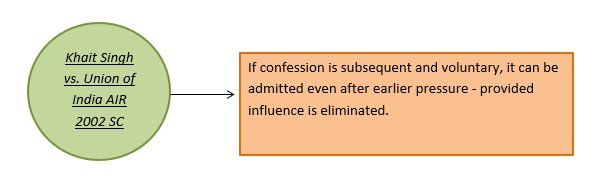
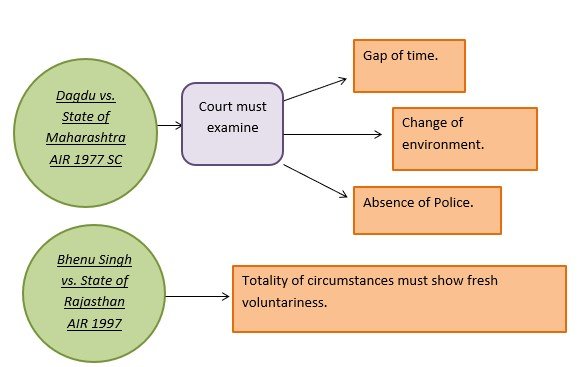
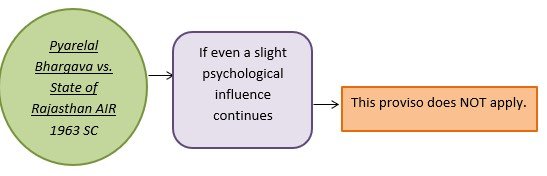
Provided that if the confession is made after the impression caused by any such inducement, threat, coercion or promise has, in the opinion of the Court, been fully removed, it is relevant:
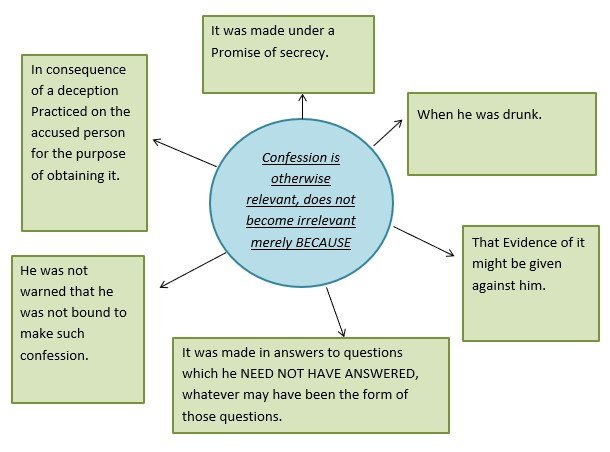
Provided further that if such a confession is otherwise relevant, it does not become irrelevant merely because it was made under a promise of secrecy, or in consequence of a deception practiced on the accused person for the purpose of obtaining it, or when he was drunk, or because it was made in answer to questions which he need not have answered, whatever may have been the form of those questions, or because he was not warned that he was not bound to make such confession, and that evidence of it might be given against him.
A confession is irrelevant in a criminal proceeding if it appears to the court that-
i) It was obtained by inducement, threat or promise.
ii) Came from person in authority.
iii) Related to the charge in question, and;
iv) Was such that it would make the accused believe he would gain an advantage or avoid an evil by confessing.
Reference Cases-
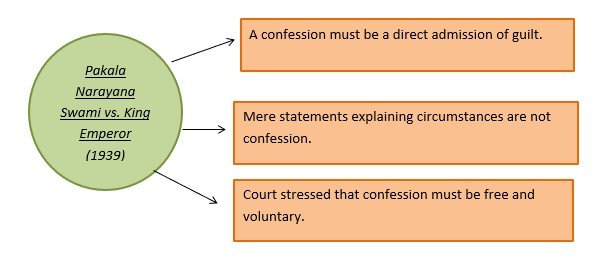
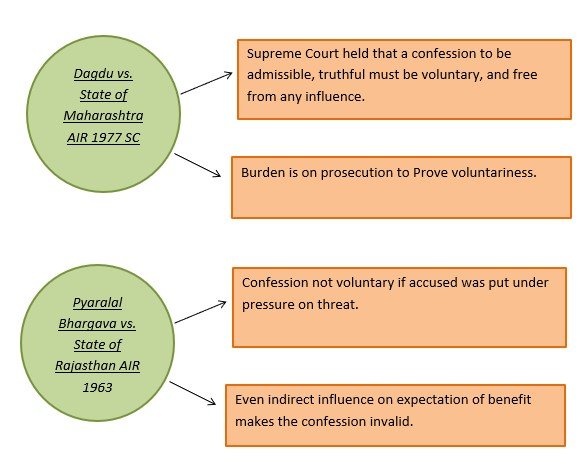
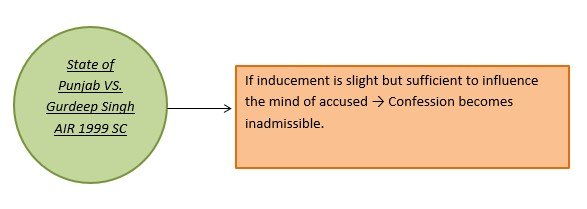
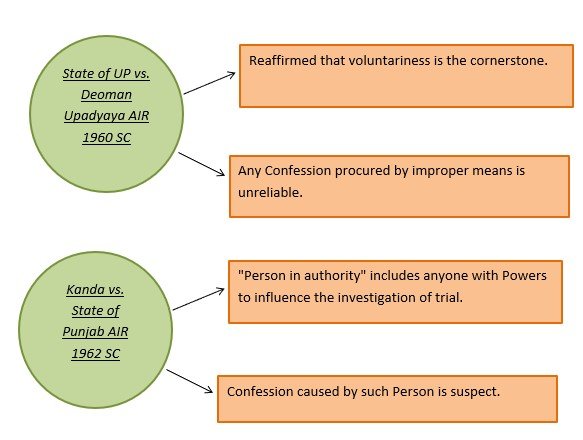
1st Proviso-
If the court believes that the inducement, threat or promise has ceased to operate, and the confession fully was made after the influence ended, then the confession becomes relevant.
Reference Cases-
2nd Proviso-
Confession to Police Officers (Sec. 23)-
Section 23 (1)-
Any confession made to a police officer is inadmissible and cannot be proved against the accused.
Absolute prohibition-
Even if the confession is-
→ Voluntary
→ Truthful
→ Recorded honestly
→ Made without threat
It is still invalid if made to a Police Officer.
Object:-
→ Prevent Police torture and coercion.
→ Prevent fabrication of confession.
→ Protect accused under Article 20(3) - Right against self-incrimination.
→ Ensure confessions are made only before a Magistrate, not Police.
Reference Cases and Principles-
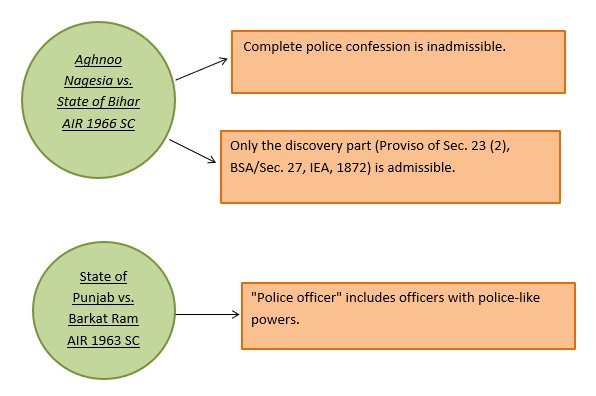
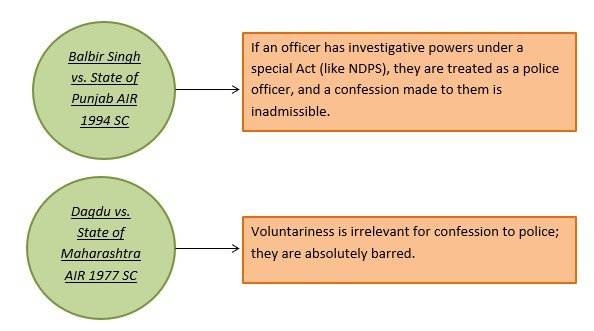
Section 23 (2)-
A confession made by a person while they are in the custody of the police is inadmissible unless it is made in the immediate presence of a Magistrate.
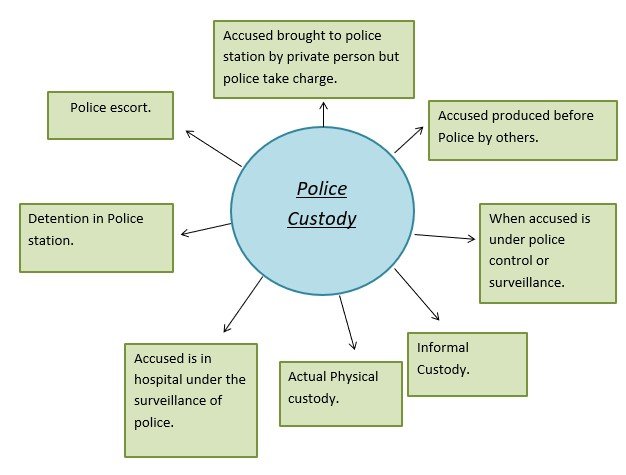
Police Custody-
Police custody is NOT ONLY formal arrest.
Proviso of Section 23(2)-
How much of information received from accused may be proved-
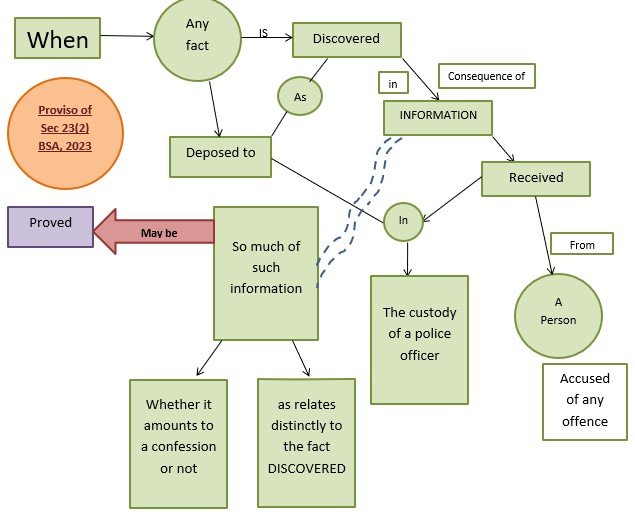
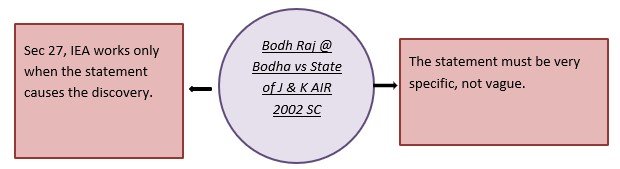
Proviso of Sec-23(2), BSA, 2023 [Sec 27, IEA, 1872] is an exception to the Sec 23(1) [Sec 25, IEA, 1872] and sec 23(2) [Sec 26, IEA, 1872] which generally bar confession by the accused person while he is in police custody.
Under this proviso of Sec. 23(2)-
-If an accused gives information to police while in custody, and
-Based on that information, a fact is actually discovered.
-Then only that fact specific portion of the information that directly leads to the discovery is admissible in court.
Essentials -
→ Accused must be in police custody.
→ Accused must give information to the police.
→ Only the part that relates distinctly to the discovery is admissible.
→ A discovery must follow.
Reference Cases-
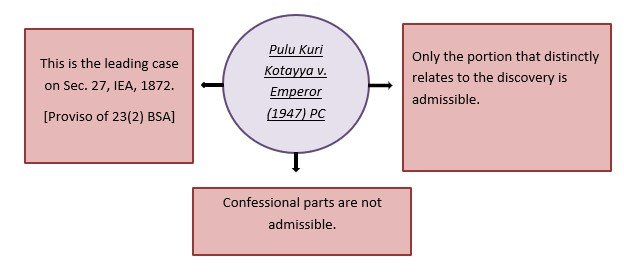
Discovery-
Discovery means finding out a new fact as a result of information given by the accused.
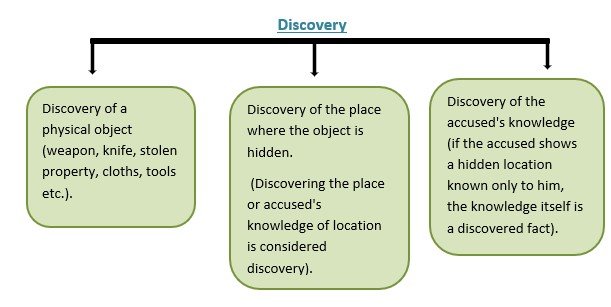
Discovery does not mean confession-
→ It is only about finding a fact connected with the crime, such as recovering an item or locating evidence.
→It is not about admitting the crime.
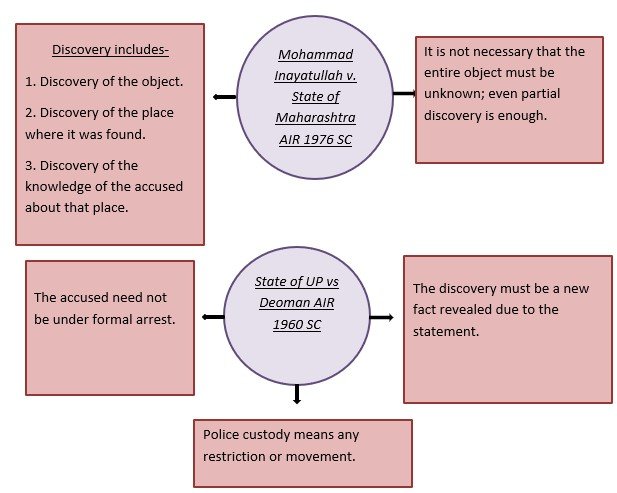
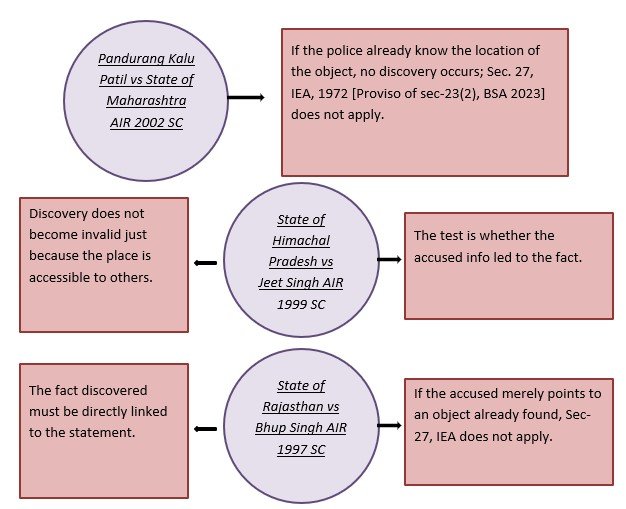
Reference Cases-

we believe in a holistic approach to legal education building not just lawyers, but socially conscious leaders of tomorrow.
