Functions of Political Parties in a Democracy
Dr. Tanmoy Mukherji
Advocate
Functions of Political Parties in a Democracy-
Tanmoy Mukherji
Advocate
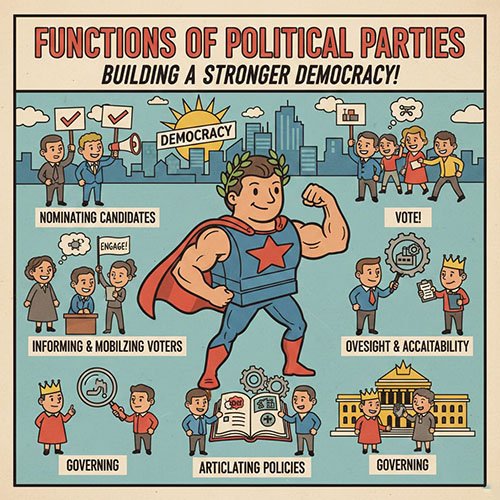
Political parties are indispensable institutions in a democratic system. They act as a link between the government and the people and play a vital role in the working of democracy.
Formation of Public Opinion-
Political parties help in shaping and educating public opinion. Through election campaigns, public meetings, manifestos, debates, and media, parties inform citizens about national issues, policies, and alternatives available before them.
Contesting Elections-
One of the most important functions of political parties is to contest elections. Parties nominate candidates, organize election campaigns, mobilize voters, and provide a platform for political competition, which is essential for democratic choice.
Formation of Government
In a democracy, the party or coalition that secures a majority forms the government. Political parties provide leadership and organize the executive by selecting ministers and leaders who implement policies and run administration.
Policy Formulation and Implementation
Political parties formulate policies and programmes based on their ideology. When in power, they translate their election promises into laws, policies, and administrative actions.
Representation of People-
Political parties represent the interests of various social, economic, regional, and ideological groups. They aggregate diverse interests and present them in a coherent manner before the government.
Link between Government and People-
Political parties act as a bridge between citizens and the government. They convey public grievances and demands to the government and explain government policies to the people.
Role of Opposition-
Parties that are not in power form the opposition. The opposition criticizes government policies, exposes failures, suggests alternatives, and ensures accountability, thereby preventing misuse of power.
Political Education-
Political parties educate citizens about democratic values, rights, duties, and political processes. They promote political awareness and encourage participation in public affairs.
Leadership Recruitment and Training-
Political parties identify, recruit, and train future political leaders. They provide opportunities for leadership development and ensure continuity in democratic governance.
Interest Aggregation-
Parties collect and combine the interests and demands of different sections of society and present them as a common programme, reducing social conflicts and promoting unity.
Ensuring Political Stability-
By providing organized platforms for political participation, parties help maintain political stability and continuity in government. Strong party systems prevent chaos and fragmentation.
Mobilization of Voters-
Political parties encourage people to participate in elections by motivating them to vote and engage in political activities, strengthening democratic participation.
Control of Government-
Through legislative debates, questions, committees, and public criticism, political parties keep a check on the government and ensure transparency and accountability.
Conclusion
Political parties are the backbone of democracy. They provide choice to voters, ensure accountability, represent public interests, and facilitate effective governance. Without political parties, democracy cannot function smoothly or meaningfully.

we believe in a holistic approach to legal education building not just lawyers, but socially conscious leaders of tomorrow.
