Interpretation of Statutes
Dr. Tanmoy Mukherji
Advocate.
Interpretation of Statutes-
Tanmoy Mukherji
Advocate
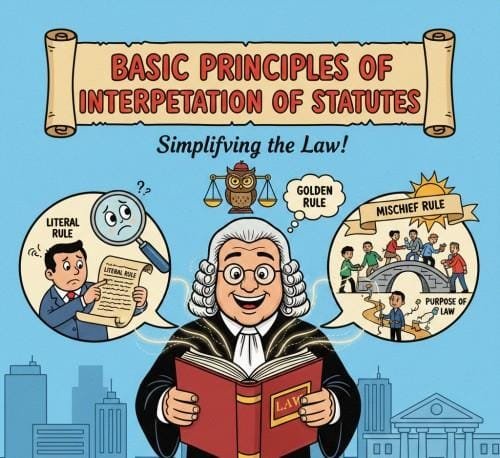
Basic principles of Interpretation of Statutes: -
The basic rules of Interpretation are—
I) intention of the legislature.
II) statutes must be read as a whole in its context,
III) statutes to be construed to make it effective and workable,
IV) if meaning and words are plain, effect must be given to it irrespective of the consequences.
I) Intention of the legislature—
The first and primary rule of interpretation is that the intention of the legislature must be found in the words used by the legislature itself.
In RND Chamarbaugwala v. Union of India, AIR 1957 SC 628, it was held that: "a statute is an edict of the legislature and the conventional way of interpreting or construing a statute is to seek the intention of its maker."
In Institute of Chartered Accountants of India v. Price Waterhouse, AIR 1998 SC 74, it was held that the true intention of the legislation is to act upon the study of Judicature - mens or sententia legis.
In Vatia International v. Bulk SA, AIR 2002 SC, it was held that if a statutory provision is open to more than one interpretation the Court has to choose that interpretation which represents the true intention of the legislature.
In Sanjeev Coke Manufacturing Co. v. Bharat Coking Coal Ltd., AIR 1983 SC, it was held that in good old days it was permissible for the judges to go to the legislature and enquire what they meant, where the language of an Act was ambiguous or contradictory but happily enough the practice is dead and there is no hope of its revival.
In B. Kandaswamy v. Gomathi Ammal, AIR 2001 SC, it was held that a question may arise which may be answered differently in different contexts whether building includes land over which the super structure stands or whether it is confined to the super structure.
According to Lord Cranworth, L.C., in Jane Straford Boyse v. John T. Rossborough (1857) 6 HLC 2, "there is no possibility of mistaking midnight for noon; but of what precise moment twilight becomes darkness is hard to determine."
In State of Bombay v. Hospital Mazdoor Sabha, AIR 1960 SC, it was held that the Courts although conscious of a dividing line, do not attempt to draw it for reasons of practical impossibility, and decide the particular case in hand as falling within or outside the purview of the relevant words of the statute, after laying down appropriately some general working principles.
In State of Himachal Pradesh v. Kailash Chand Mahajan, AIR 1992 SC, it was held that the intention of legislature thus assimilates two aspects:
->In one aspect it carries the concept of "meaning" that is; what the words mean and in another aspect, it conveys the concept of purpose and object of the reason spirit pervading through the statute.
II)Statute must be read as a whole in its context-
When the question arises as to the meaning of a certain provision in a statute, it is not only legitimate but also proper to read that provision in its context.
In Philips India Ltd. v. Labour Court, AIR 1985 SC, it was held that it is a rule now firmly established that the intention of the legislature must be found by reading the statute as a whole.
In Poppatlal Shah v. State of Madras AIR 1953 SC, it was held that it is a settled rule of construction that to ascertain the legislative intent, all the constituent parts of the statute are to be taken together.
In Bangalore Water Supply and Sewerage Board v. A. Rajappa, AIR 1978 SC, it was held that the same word may mean one thing in one context and another in a different context.
In Municipal Corporation of Hyderabad v. P.N Murthy, AIR 1987 SC, the question before the Court was whether corporation property in possession of allottees under hire purchase agreements was exempt from tax. The Court held reading both the section 202 & 204 of the Hyderabad Municipal Corporation Act, 1955 together that such property was not exempt. And the exemption was limited to those cases where property vested in corporation both in the title and in possession as otherwise Section 204 would become inoperative.
In State of Bihar v. Hira Lal Kejriwal AIR 1960 SC 47, it was held that the principle that the statute must be read as a whole is equally applicable to different part of the same section and it is not permissible to omit any part of it. The whole section should be read together.
III) Statute must be construed to make it to make it effective & workable-
In Tinsukhia Electric Supply Co. Ltd. v. State of Assam, AIR 1990 SC, it was held that the Courts strongly lean against a construction which reduces the statute to a futility.
In CIT v. Teja Singh AIR 1959 SC, it was held that a Statute or any enacting provision therein must be construed as to make it effective and operative on the principle expressed in the maxim " ut res magis valeat quam pereat".
In Corporation of Calcutta v. Liberty Cinema, AIR 1965 SC, it was held that it is an application of this principle that counts while pronouncing upon the Constitutionality and preserve a construction which keeps the statute within the competence of the legislature.
In Balram Kumawat v. Union of India AIR 2003 SC, it was held that Courts should avoid a construction which would reduce the legislation to futility and should rather accept the bolder construction based on the view that parliament would legislate only for the purpose of bringing about an effective result.
In Govt. of AP v. GVK Girls High School, AIR 2000 SC, it was held that validating Act cannot be valid and effective without amending the law from which the said legal consequence could follow if it simply deems a legal consequence.
IV) If meaning and words are plain, effect must be given to it irrespective of consequence-
In Collector of customs v. Digvijay Sinhji Spinning and weaving mills Ltd., AIR 1961 SC, it was held that if the words of the Statute are in themselves precise and unambiguous, then no more can be necessary than to expound those words in their natural and ordinary sense.
In Kanailal Sur v. Paramnidhi Sadhukhan, AIR 1957 SC, Gajendragadkar, J., said that if the words used are capable of one construction only then it would not be open to the Courts to adopt any other hypothetical construction on the ground that such construction is more consistent with the alleged object and policy of the Act.
In Rananjaya Singh v. Baijnath Singh, AIR 1954 SC, it was held that the spirit of the law may only be well be an elusive and unsafe guide and the supposed spirit can certainly not be given effect to in opposition to the plain language of the Sections of the Act.
In Sajjan Singh v. State of Punjab AIR 1964 SC, Supreme Court gave effect to the plain meaning of the Sec. 5 (3) and Sec. 4 (1) one of the Prevention of Corruption Act 1947.

we believe in a holistic approach to legal education building not just lawyers, but socially conscious leaders of tomorrow.
